
Introduction to Pharmaceutical Formulation Research
Pharmaceutical formulation research is the systematic, science-driven process by which a therapeutic molecule identified in early drug discovery is converted into a safe, effective, stable, and manufacturable medicine that can be administered to a patient. This introductory chapter establishes the conceptual foundation for everything that follows: the scope of pharmaceutics as a discipline, the major categories of research undertaken within it, the classification of dosage forms available to the formulator, the regulatory scaffolding that governs every decision made during development, and the overall workflow that carries a candidate molecule from the laboratory bench to a regulatory dossier ready for submission.
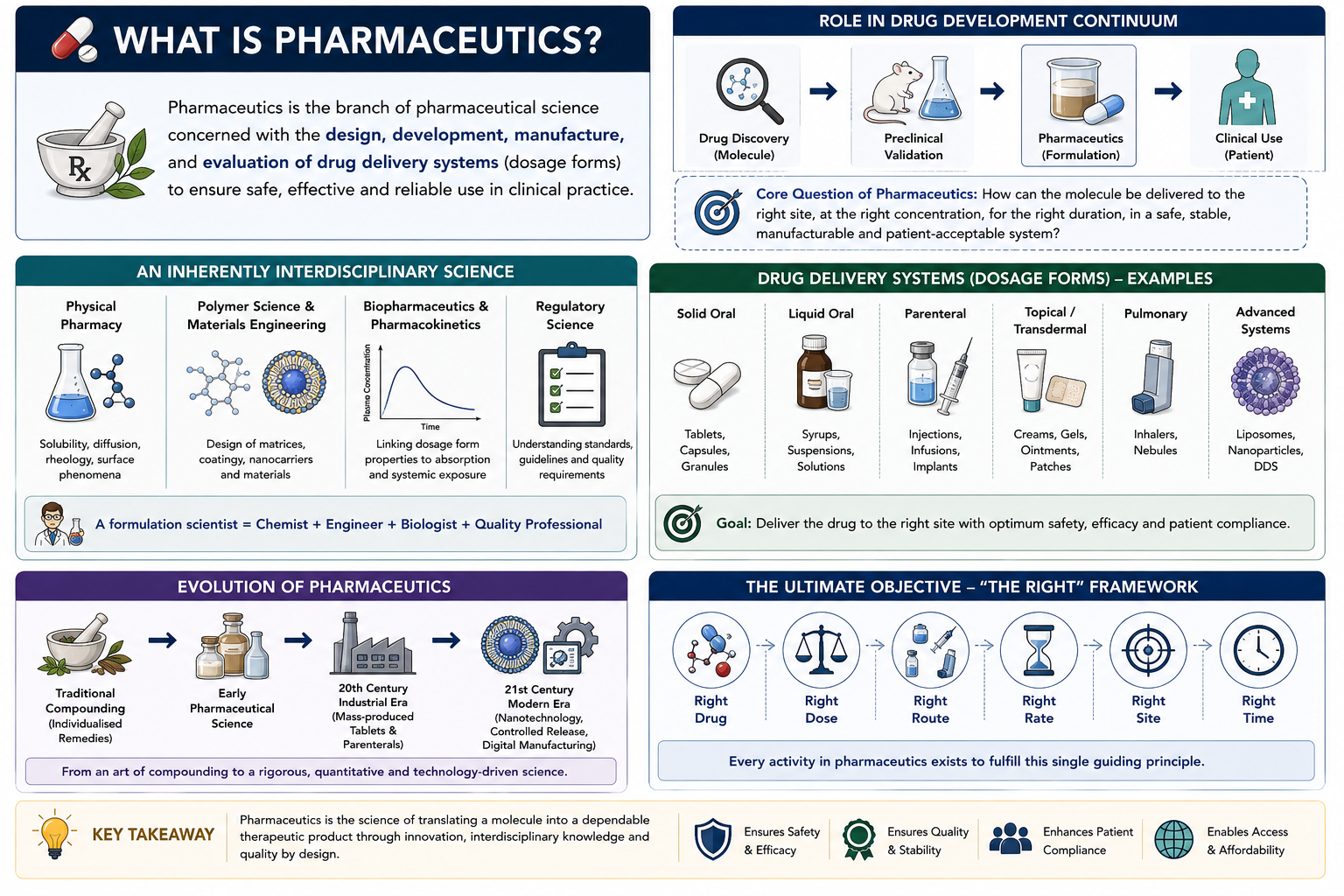
Pharmaceutics is the branch of pharmaceutical science concerned with the design, development, manufacture, and evaluation of drug delivery systems, more commonly referred to as dosage forms. It occupies a pivotal position in the drug development continuum, forming the bridge between the discovery of a biologically active molecule and its safe, effective use in clinical practice. Where medicinal chemistry and pharmacology are concerned with identifying and validating a molecule capable of producing a desired biological effect, pharmaceutics is concerned with a different but equally critical question: how can that molecule be delivered to the right site of action, at the right concentration, for the right duration, using a system that can be reliably manufactured at scale and that remains stable throughout its shelf life?
The discipline is inherently interdisciplinary. It draws upon physical pharmacy for an understanding of solubility, diffusion, rheology, and surface phenomena; upon polymer science and materials engineering for the design of matrices, coatings, and nanocarriers; upon biopharmaceutics and pharmacokinetics for an understanding of how a dosage form's physicochemical properties translate into absorption and systemic exposure; and upon regulatory science for an understanding of the standards a product must meet before it can be approved for human use. A formulation scientist therefore functions simultaneously as a chemist, an engineer, a biologist, and a quality professional.
Historically, pharmaceutics evolved from the traditional art of compounding — where a pharmacist prepared individualised remedies at the point of dispensing — into a rigorous, quantitative science underpinned by physical chemistry and industrial process engineering. The twentieth century saw this transition accelerate dramatically with the advent of mass-produced tablets and parenteral products, and the twenty-first century has extended the discipline further into nanotechnology, controlled-release engineering, and digitally enabled manufacturing. Modern pharmaceutics is therefore best understood not as a static body of recipes but as a continuously evolving science that integrates new analytical tools, computational methods, and materials as they become available.
The ultimate objective of pharmaceutics can be summarised in a single guiding principle often referred to informally as the 'right' framework: delivering the right drug, in the right dose, through the right route, at the right rate, to the right site, at the right time. Every activity described in the chapters that follow — from the characterisation of a drug's physicochemical properties to the design of a nanoparticle carrier to the statistical modelling of a shelf-life — exists in service of that single principle.
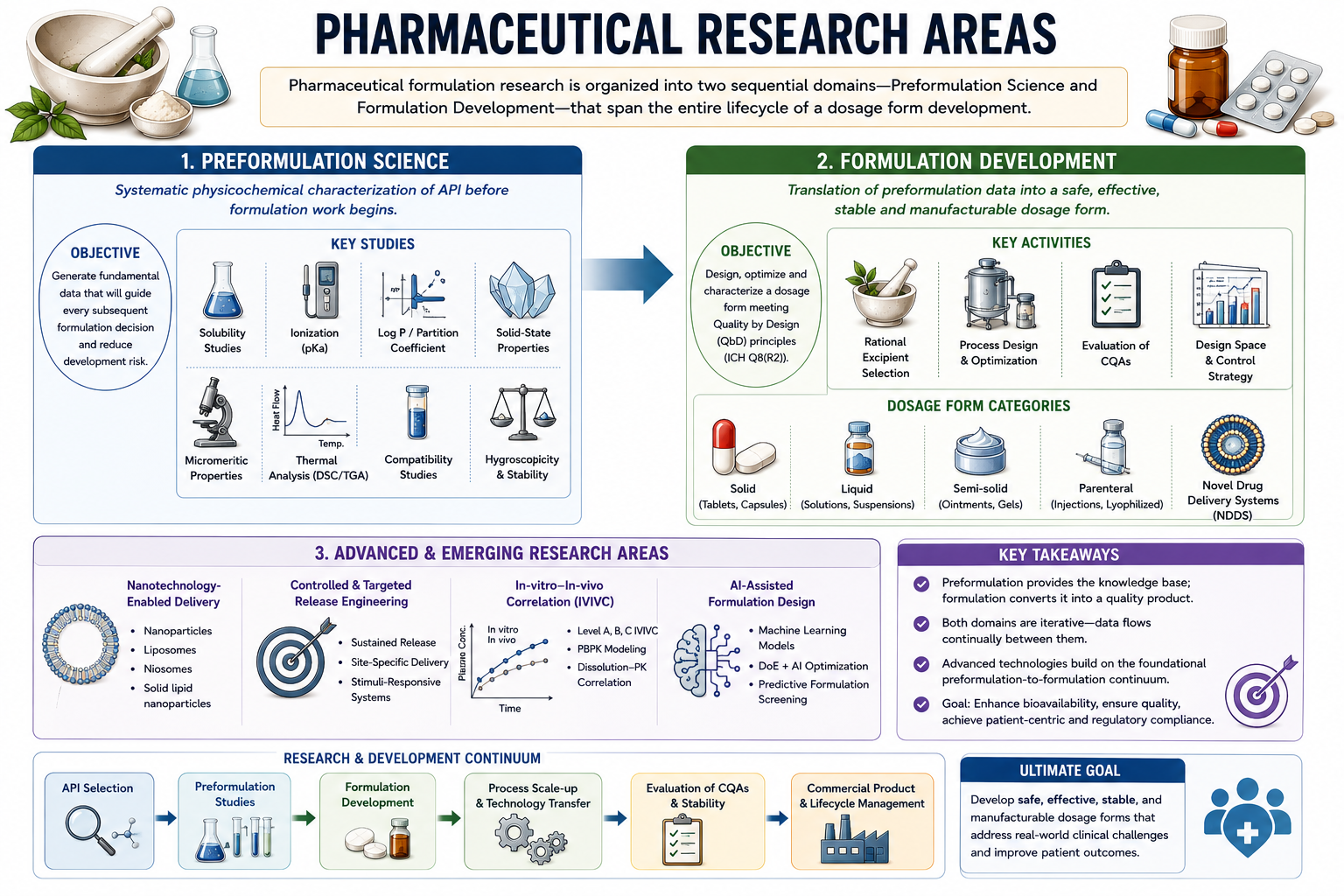
Pharmaceutical formulation research is conventionally organised into two broad, sequential domains that together span the entire developmental lifecycle of a dosage form: preformulation science and formulation development. These domains are not rigidly separated in practice — data generated in one continually informs decisions made in the other — but they represent distinct phases of intellectual and experimental activity, each with its own objectives, techniques, and deliverables.
Preformulation science is the earlier of the two domains and is concerned with the systematic physicochemical characterisation of the active pharmaceutical ingredient, or API, before any formulation work begins. Its purpose is to generate the fundamental dataset — solubility, ionisation behaviour, partition coefficients, solid-state properties, and compatibility with common excipients — that will guide every subsequent formulation decision. A poorly characterised molecule invites late-stage failures: an unexpected polymorphic transition during scale-up, an incompatibility between the drug and a chosen excipient, or a dissolution profile that fails to meet regulatory acceptance criteria. Investing rigorously in preformulation therefore reduces both developmental risk and cost.
Formulation development is the domain in which the preformulation dataset is translated into an actual, manufacturable dosage form. This involves the rational selection of excipients, the design and optimisation of a manufacturing process, and the systematic characterisation of Critical Quality Attributes, commonly abbreviated CQAs, in accordance with the principles of Quality by Design established under ICH Q8(R2). Formulation development spans the full range of dosage form categories — solid, liquid, semi-solid, and parenteral — as well as the more specialised domain of novel drug delivery systems, which is treated separately given its distinct scientific and regulatory considerations.
Beyond these two core domains, contemporary pharmaceutics research increasingly incorporates advanced disciplines such as nanotechnology-enabled delivery, controlled and targeted release engineering, in-vitro–in-vivo correlation modelling, and, most recently, artificial-intelligence-assisted formulation design. These advanced areas do not replace the foundational preformulation-to-formulation continuum; rather, they build upon it, applying the same underlying physicochemical principles to increasingly sophisticated delivery challenges such as poor oral bioavailability, site-specific targeting, and patient-centric dosing.
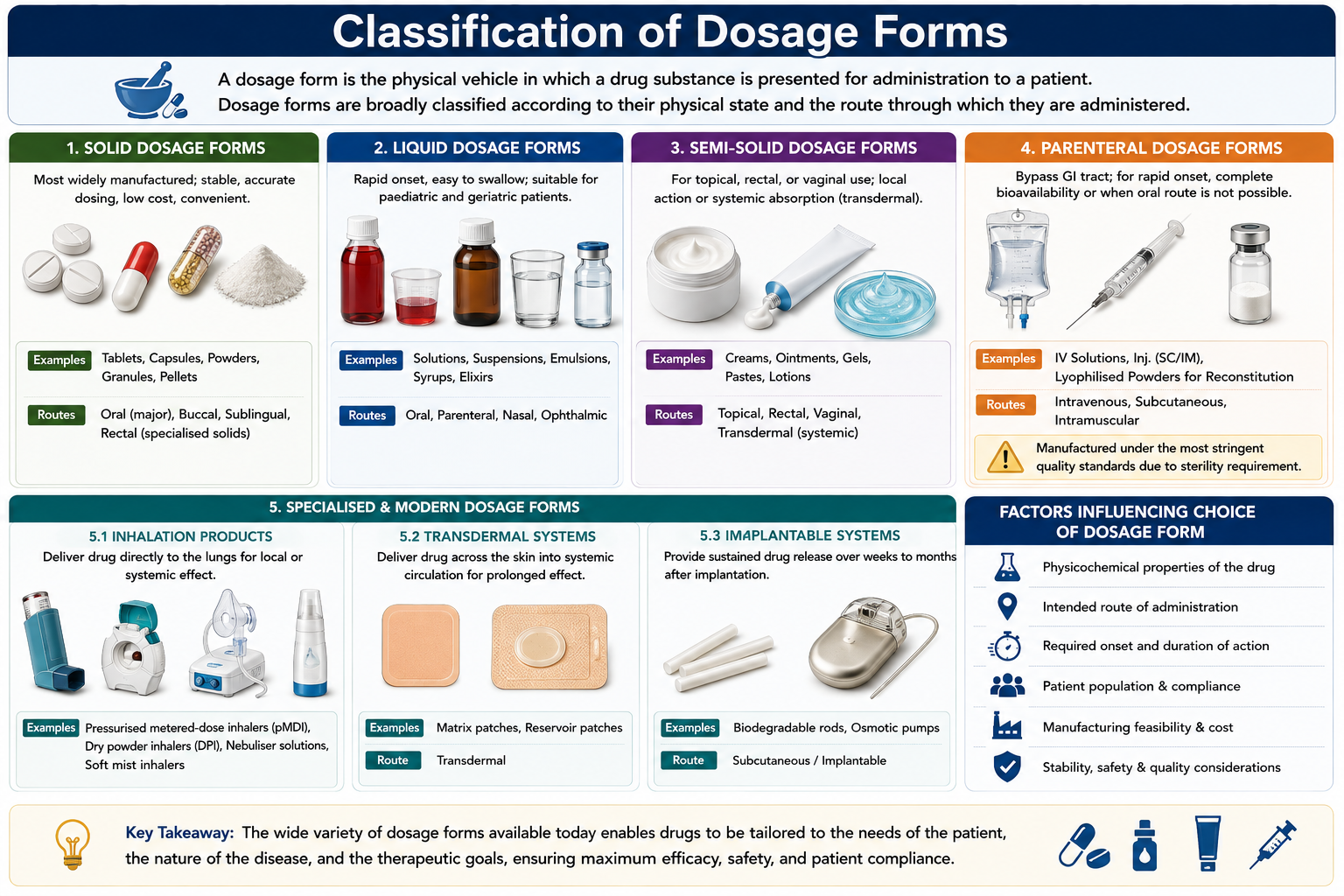
A dosage form is the physical vehicle in which a drug substance is presented for administration to a patient. The choice of dosage form is dictated by numerous factors, including the physicochemical properties of the drug, the intended route of administration, the required onset and duration of action, patient population and compliance considerations, and manufacturing feasibility. Dosage forms are broadly classified according to their physical state and the route through which they are administered.
Solid dosage forms — tablets, capsules, powders, granules, and pellets — represent the most widely manufactured category, valued for their chemical stability, ease of accurate dosing, low manufacturing cost per unit, and convenience for the patient. They are administered principally by the oral route, though specialised solid forms exist for buccal, sublingual, and rectal administration. Liquid dosage forms, encompassing true solutions, suspensions, emulsions, syrups, and elixirs, offer the advantage of rapid onset and ease of swallowing for paediatric and geriatric patients, but present greater challenges in chemical and physical stability, microbial contamination control, and accurate dose measurement. Liquids may be formulated for oral, parenteral, nasal, or ophthalmic use depending on their composition.
Semi-solid dosage forms — creams, ointments, gels, pastes, and lotions — are designed predominantly for topical, rectal, or vaginal application, where localised action at or near the site of application is desired, although some semi-solids are engineered for systemic transdermal absorption. Parenteral dosage forms, including intravenous solutions, subcutaneous and intramuscular injections, and lyophilised powders for reconstitution, bypass the gastrointestinal tract entirely and are reserved for situations demanding rapid onset, complete bioavailability, or administration to patients unable to take oral medication; their manufacture is governed by the most stringent quality standards in the entire pharmaceutical industry owing to the requirement for sterility.
Beyond these conventional categories, the modern pharmaceutical landscape includes inhalation products — pressurised metered-dose inhalers, dry powder inhalers, nebuliser solutions, and soft mist inhalers — engineered for direct pulmonary deposition; transdermal systems such as matrix and reservoir patches that deliver drug continuously across the skin into systemic circulation; and implantable systems, including biodegradable rods and osmotic pumps, that provide sustained drug release over weeks to months following a single surgical or subcutaneous placement. Each of these specialised categories demands its own body of formulation science, discussed in detail in later chapters of this text.
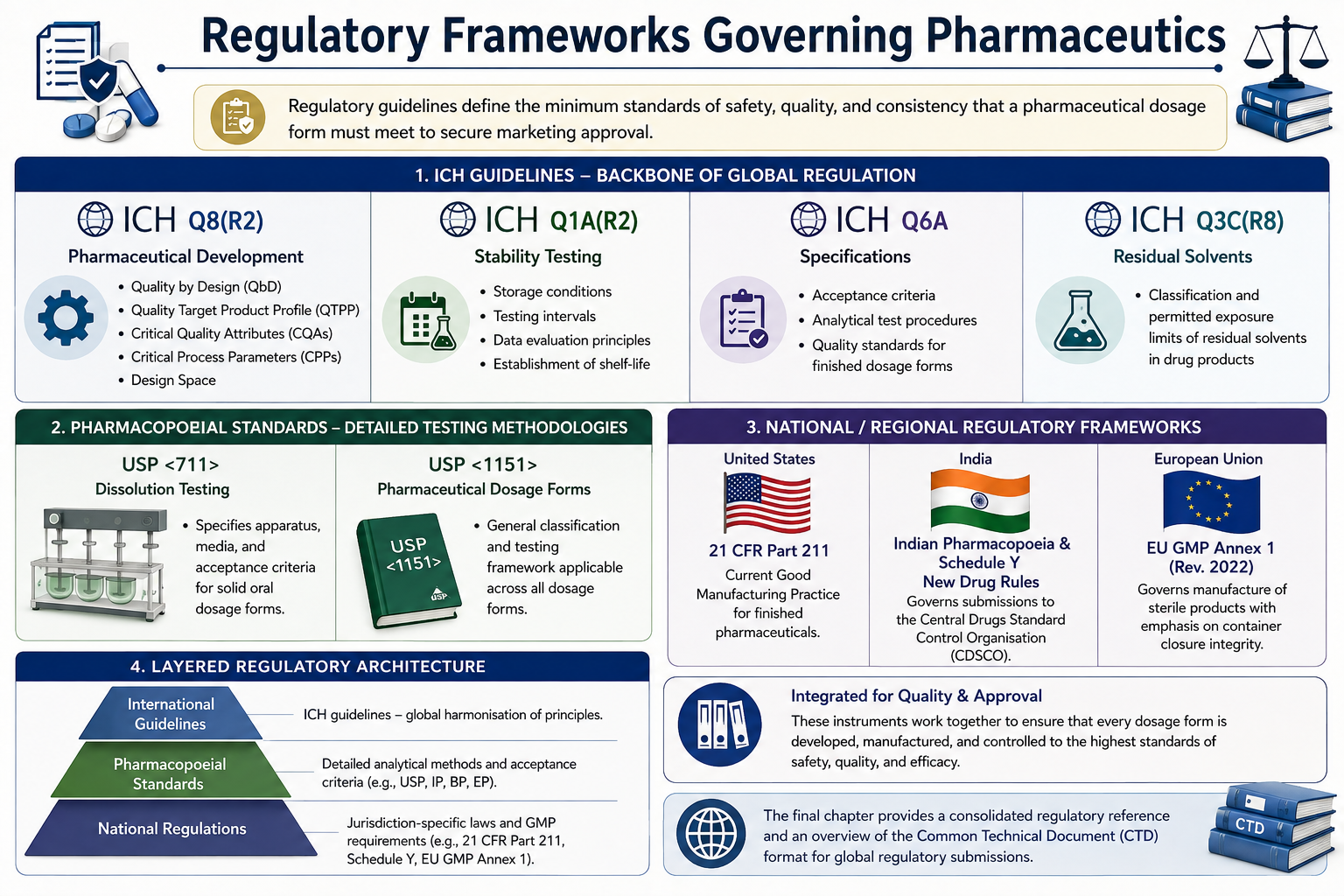
No pharmaceutical dosage form can be developed, manufactured, or marketed in isolation from the regulatory framework that governs it. Regulatory guidelines are not bureaucratic afterthoughts appended to the science; they are, in a very real sense, an integral part of the scientific method as applied to pharmaceutics, because they codify the minimum standards of safety, quality, and consistency that a formulation must demonstrably meet. A formulation scientist who does not understand the regulatory context of their work risks generating data that, however scientifically sound, is unusable for the purpose of securing marketing approval.
The International Council for Harmonisation, widely known by its acronym ICH, issues the guidelines that form the backbone of global pharmaceutical regulation. ICH Q8(R2) governs pharmaceutical development and introduced the Quality by Design paradigm, formalising concepts such as the Quality Target Product Profile, Critical Quality Attributes, Critical Process Parameters, and design space that now underpin rational formulation design worldwide. ICH Q1A(R2) governs the stability testing of new drug substances and products, defining the storage conditions, testing intervals, and data-evaluation principles used to establish shelf-life. ICH Q6A addresses the setting of specifications — the acceptance criteria and analytical test procedures a finished dosage form must satisfy — while ICH Q3C(R8) governs the classification and permitted-exposure limits of residual solvents that may remain in a drug product following manufacture.
Pharmacopoeial standards provide the detailed analytical methodology that operationalises these high-level guidelines. The United States Pharmacopeia chapter USP <711> specifies dissolution testing apparatus, media, and acceptance criteria for solid oral dosage forms, while USP <1151> provides the general classification and testing framework applicable across all pharmaceutical dosage forms. National regulatory instruments layer additional, jurisdiction-specific requirements atop this international framework: in the United States, 21 CFR Part 211 codifies current Good Manufacturing Practice for finished pharmaceuticals; in India, the Indian Pharmacopoeia and Schedule Y of the New Drug Rules govern submissions to the Central Drugs Standard Control Organisation; and within the European Union, EU GMP Annex 1, substantially revised in 2022, governs the manufacture of sterile products with particular emphasis on container closure integrity.
Taken together, these instruments form a layered regulatory architecture — international harmonisation guidelines at the top, pharmacopoeial testing methodologies in the middle, and national implementing regulations at the base — that a formulation scientist must navigate simultaneously with the underlying pharmaceutical science. Later chapters of this text return repeatedly to these guidelines as they apply to specific stages of development, and the final chapter provides a consolidated regulatory reference and a discussion of the Common Technical Document format used for global regulatory submissions.
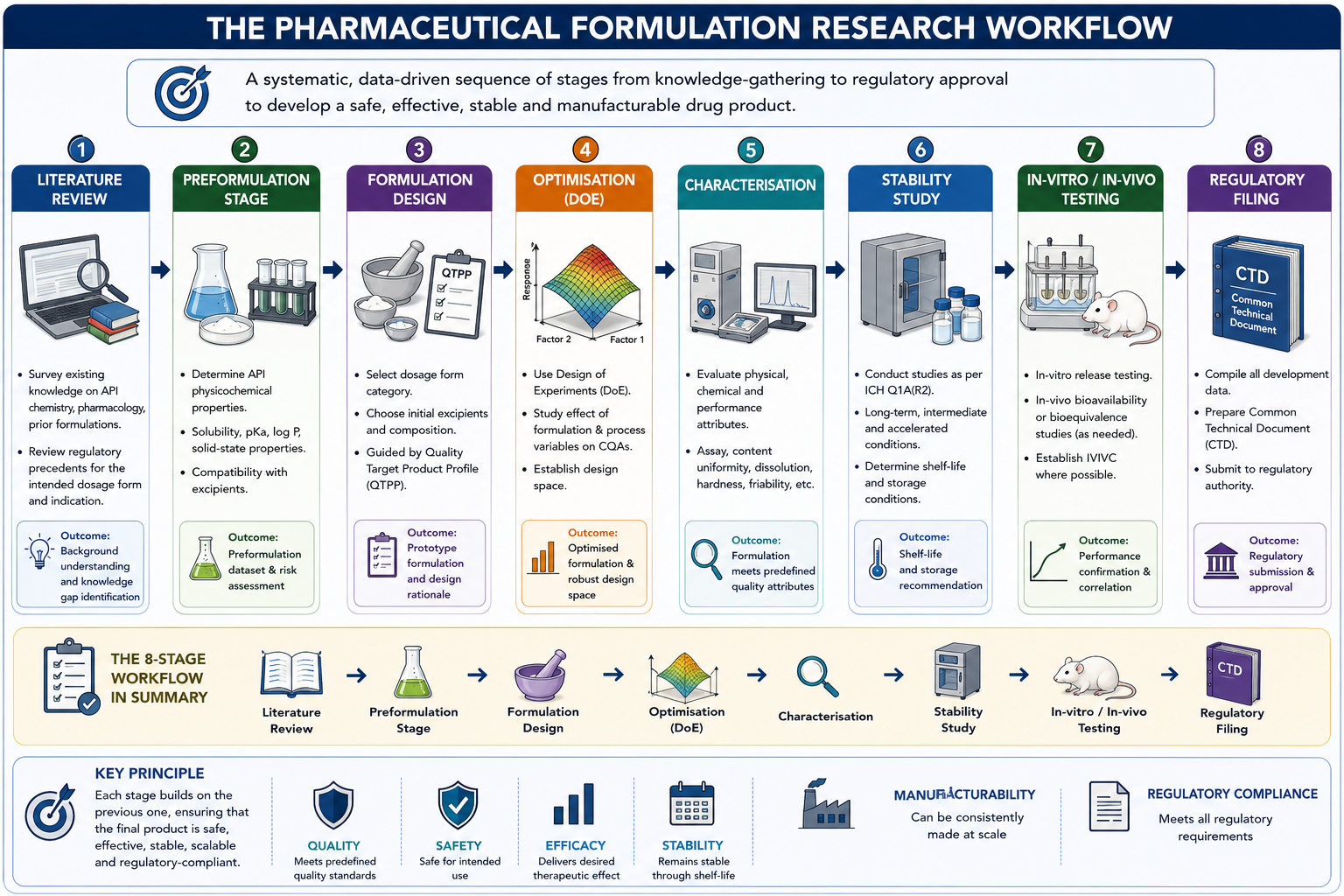
Although every drug development programme has its own particular challenges, pharmaceutical formulation research follows a broadly consistent sequence of stages, each building on the data and decisions generated by the one before it. Understanding this overall workflow provides an essential map for navigating the more detailed, phase-specific chapters that follow in this text.
The process typically begins with a comprehensive literature review, in which the formulation scientist surveys existing knowledge of the drug candidate's chemistry, pharmacology, and any prior formulation attempts, together with the regulatory precedents relevant to the intended dosage form and indication. This is followed by the preformulation stage, during which the physicochemical properties of the API — its solubility, ionisation behaviour, solid-state characteristics, and compatibility with candidate excipients — are systematically established, as detailed in the following chapter. Armed with this dataset, the scientist proceeds to formulation design, selecting a dosage form category and an initial excipient composition guided by the Quality Target Product Profile.
The initial formulation is rarely optimal, and so an optimisation stage follows, typically employing Design of Experiments methodology to systematically explore the relationship between formulation and process variables and the resulting Critical Quality Attributes, thereby identifying a robust design space within which the product can be reliably manufactured. The optimised formulation then undergoes comprehensive characterisation against its predefined quality attributes, followed by formal stability studies conducted under the conditions specified by ICH Q1A(R2) to establish an appropriate shelf-life and storage recommendation.
Where relevant, in-vitro release testing and, where required, in-vivo bioavailability or bioequivalence studies are conducted to confirm that the formulation performs as intended and, where possible, to establish an in-vitro–in-vivo correlation that can substitute for costly clinical studies in future manufacturing-change assessments. The workflow culminates in regulatory filing, during which the accumulated body of pharmaceutical development data is compiled into the Common Technical Document format for submission to the relevant national or regional regulatory authority. Each of these eight stages — literature review, preformulation, formulation design, optimisation, characterisation, stability study, in-vitro/in-vivo testing, and regulatory filing — is examined in dedicated depth in the chapters that follow.