
Preformulation Studies
Preformulation is the first substantive scientific stage of pharmaceutical product development. It comprises the systematic study of the physicochemical properties of a new drug substance, generating the information necessary to design a stable, safe, and effective dosage form. The data produced during preformulation defines the fundamental nature of the molecule and directly guides the formulation strategy, excipient selection, and storage conditions that follow. A rigorous preformulation programme substantially reduces the risk of costly late-stage formulation failures and forms the essential evidentiary basis upon which every later development decision rests.
Physical characterisation of the drug substance establishes its fundamental solid-state identity and is typically the earliest preformulation activity undertaken. Differential Scanning Calorimetry, commonly abbreviated DSC, is the principal technique employed, measuring the heat flow associated with thermal transitions — melting, crystallisation, glass transition, and decomposition — as a sample is heated at a controlled rate. A sharp, well-defined melting endotherm is generally indicative of a pure, single crystalline form, whereas a broad or multiple endotherm suggests the presence of impurities, a polymorphic mixture, or an amorphous component. DSC is frequently complemented by hot-stage microscopy, which allows the direct visual observation of melting and recrystallisation events under polarised light, and by X-ray Powder Diffraction, which provides a definitive fingerprint of crystalline structure and is the gold-standard technique for detecting and quantifying polymorphism.
Polymorphism — the capacity of a single chemical entity to exist in more than one crystalline arrangement — is a phenomenon of enormous pharmaceutical significance, since different polymorphic forms of the same drug can exhibit markedly different solubility, dissolution rate, and even chemical stability, despite being chemically identical. A formulation developed using a metastable polymorph risks unpredictable conversion to a more thermodynamically stable, and often less soluble, form during manufacture or storage, with consequent loss of bioavailability. Preformulation scientists therefore invest considerable effort in polymorph screening, typically through controlled crystallisation from a range of solvents, to identify the most stable and pharmaceutically desirable form before formulation work begins.
Particle size and particle size distribution are further critical physical attributes, influencing dissolution rate, powder flow, content uniformity, and, for inhalation and parenteral products, the very feasibility of administration. Particle size is typically measured by laser diffraction for bulk powders or by microscopy and dynamic light scattering for finer suspensions and nanoparticulate systems. Related physical properties assessed during this stage include bulk and tapped density, which inform powder flow and compressibility behaviour relevant to tablet manufacture, and hygroscopicity, the tendency of a solid to absorb atmospheric moisture, which has direct implications for packaging selection and storage condition specification.
Collectively, these physical characterisation studies establish an unambiguous identity for the drug substance and flag, at the earliest possible stage, any solid-state risks — such as an unfavourable polymorphic landscape or excessive hygroscopicity — that must be actively managed throughout subsequent formulation development.
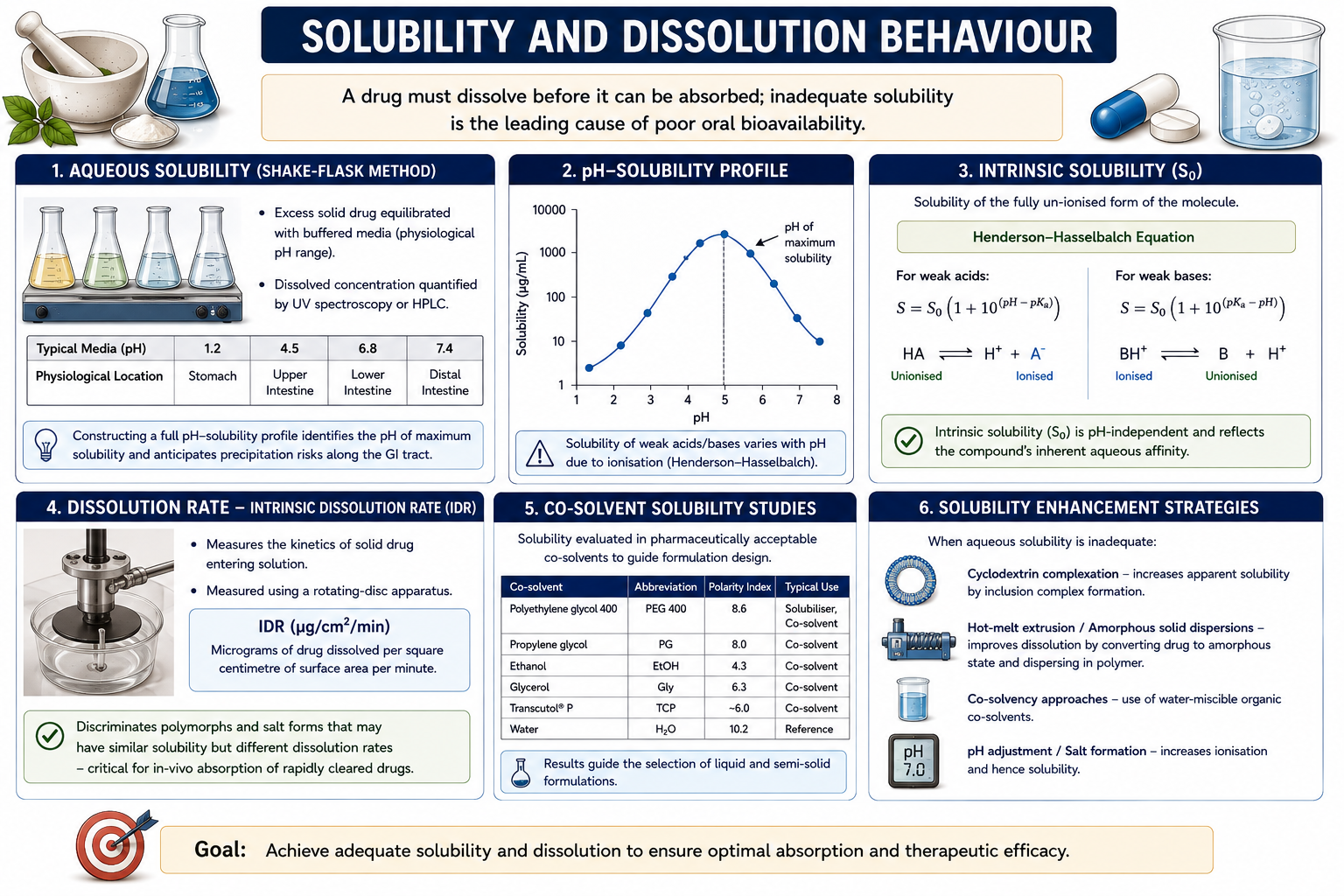
Aqueous solubility is arguably the single most consequential physicochemical property assessed during preformulation, since a drug must dissolve before it can be absorbed, and inadequate solubility is the leading cause of poor oral bioavailability among modern drug candidates. Solubility is conventionally measured using the shake-flask method, in which an excess of solid drug is equilibrated with buffered aqueous media representative of the physiological pH range encountered along the gastrointestinal tract — typically pH 1.2, 4.5, 6.8, and 7.4 — with the dissolved concentration subsequently quantified by ultraviolet spectroscopy or high-performance liquid chromatography.
Because many drugs are weak acids or weak bases, their observed solubility varies substantially with pH, and preformulation scientists therefore construct a full pH-solubility profile to identify the pH of maximum solubility and to anticipate potential precipitation risks as the drug transits regions of differing gastrointestinal pH. A related and more fundamental parameter is the intrinsic solubility, defined as the solubility of the fully un-ionised form of the molecule; this value, related to the ionisation constant through the Henderson–Hasselbalch equation, provides a pH-independent measure of the compound's inherent aqueous affinity and is essential for rational salt-form and formulation selection.
Dissolution rate, distinct from equilibrium solubility, describes the kinetics with which solid drug enters solution and is most rigorously assessed through measurement of the Intrinsic Dissolution Rate using a rotating-disc apparatus, expressed in micrograms per square centimetre per minute. Intrinsic dissolution rate measurement is particularly valuable because it discriminates effectively between polymorphic forms and salt forms that may share similar equilibrium solubility but differ substantially in the rate at which they dissolve — a distinction of direct relevance to in-vivo absorption for rapidly cleared drugs.
Where a candidate molecule exhibits inadequate aqueous solubility, preformulation scientists evaluate its solubility in a panel of pharmaceutically acceptable co-solvents such as polyethylene glycol 400, propylene glycol, and ethanol, informing the design of liquid and semi-solid formulations. Where solubility remains a barrier to development, a range of solubility-enhancement strategies is considered at this stage, including cyclodextrin complexation, hot-melt extrusion to produce amorphous solid dispersions, co-solvency approaches, and pH-adjustment or salt-formation strategies, each of which is examined in greater depth in the chapters addressing novel drug delivery systems.
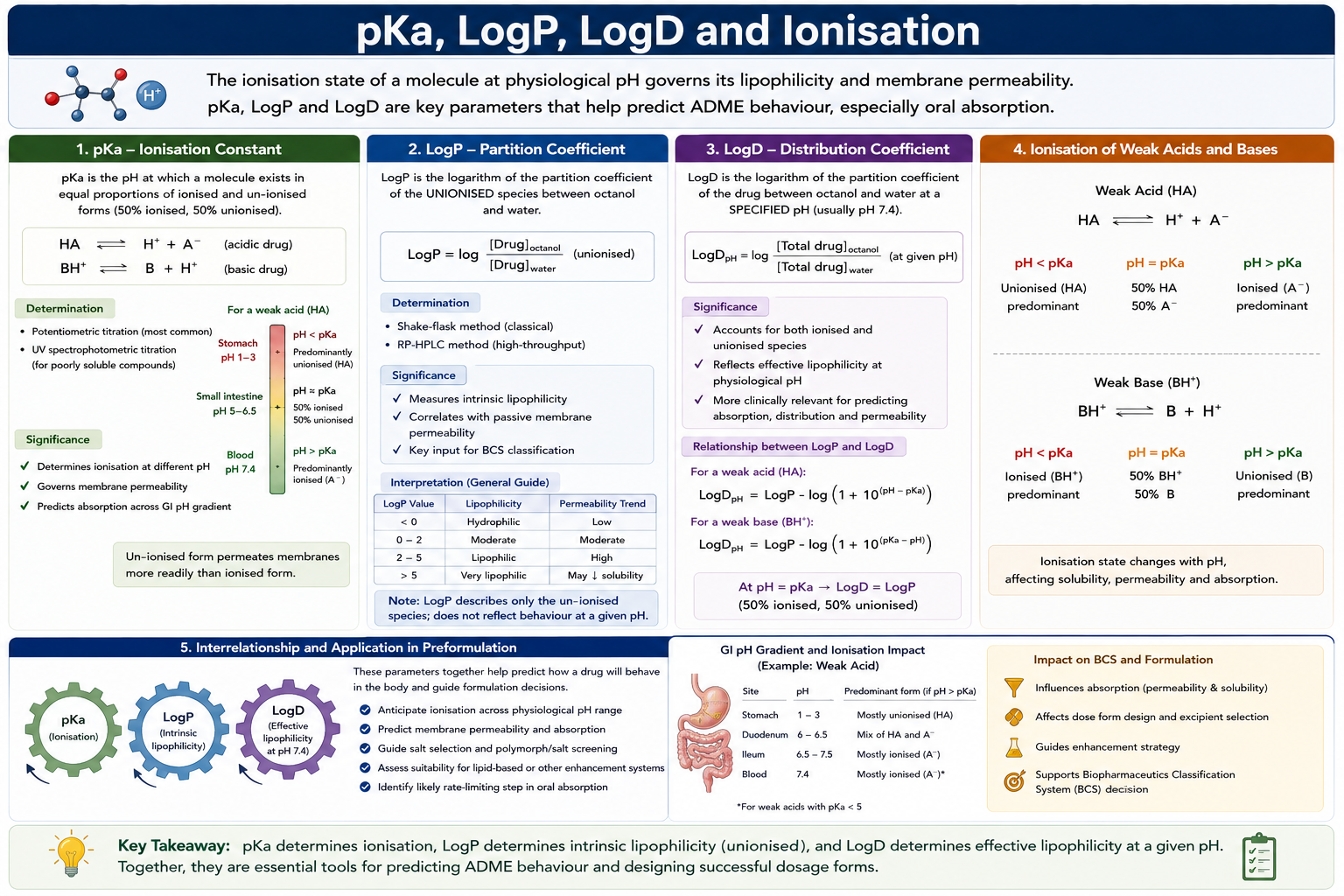
The ionisation constant, or pKa, describes the pH at which a molecule exists in equal proportions of its ionised and un-ionised forms, and it is determined experimentally by potentiometric titration or, for poorly soluble compounds, by ultraviolet spectrophotometric titration. Because the ionisation state of a molecule at physiological pH governs its membrane permeability — un-ionised species generally permeate lipid membranes more readily than their ionised counterparts — pKa is a foundational parameter for predicting gastrointestinal absorption and for anticipating how a molecule will behave across the differing pH environments of the stomach, small intestine, and systemic circulation.
The octanol–water partition coefficient, or LogP, quantifies the intrinsic lipophilicity of the un-ionised molecule, measured classically by the shake-flask method or, more efficiently for large compound sets, by reversed-phase high-performance liquid chromatography calibrated against reference standards. LogP correlates broadly with passive membrane permeability and is a key input to biopharmaceutical classification, but because it describes only the un-ionised species, it does not by itself capture how a compound will actually partition at physiological pH.
The distribution coefficient, LogD, addresses this limitation by describing the partitioning behaviour of the molecule at a specified pH, most commonly pH 7.4, accounting explicitly for the fraction of drug present in ionised form. LogD is related to LogP through the compound's pKa and the prevailing pH via a logarithmic correction term, and because it reflects the effective lipophilicity under physiologically relevant conditions, LogD is generally regarded as the more clinically meaningful parameter for predicting absorption, distribution, and membrane permeability.
Together, pKa, LogP, and LogD constitute an interlocking set of parameters that preformulation scientists use to anticipate a molecule's ionisation state and lipophilicity across the physiological pH range, informing decisions on salt selection, the feasibility of enhancement technologies such as lipid-based systems, and the likely rate-limiting step in oral absorption — considerations that feed directly into the Biopharmaceutics Classification System discussed later in this chapter.
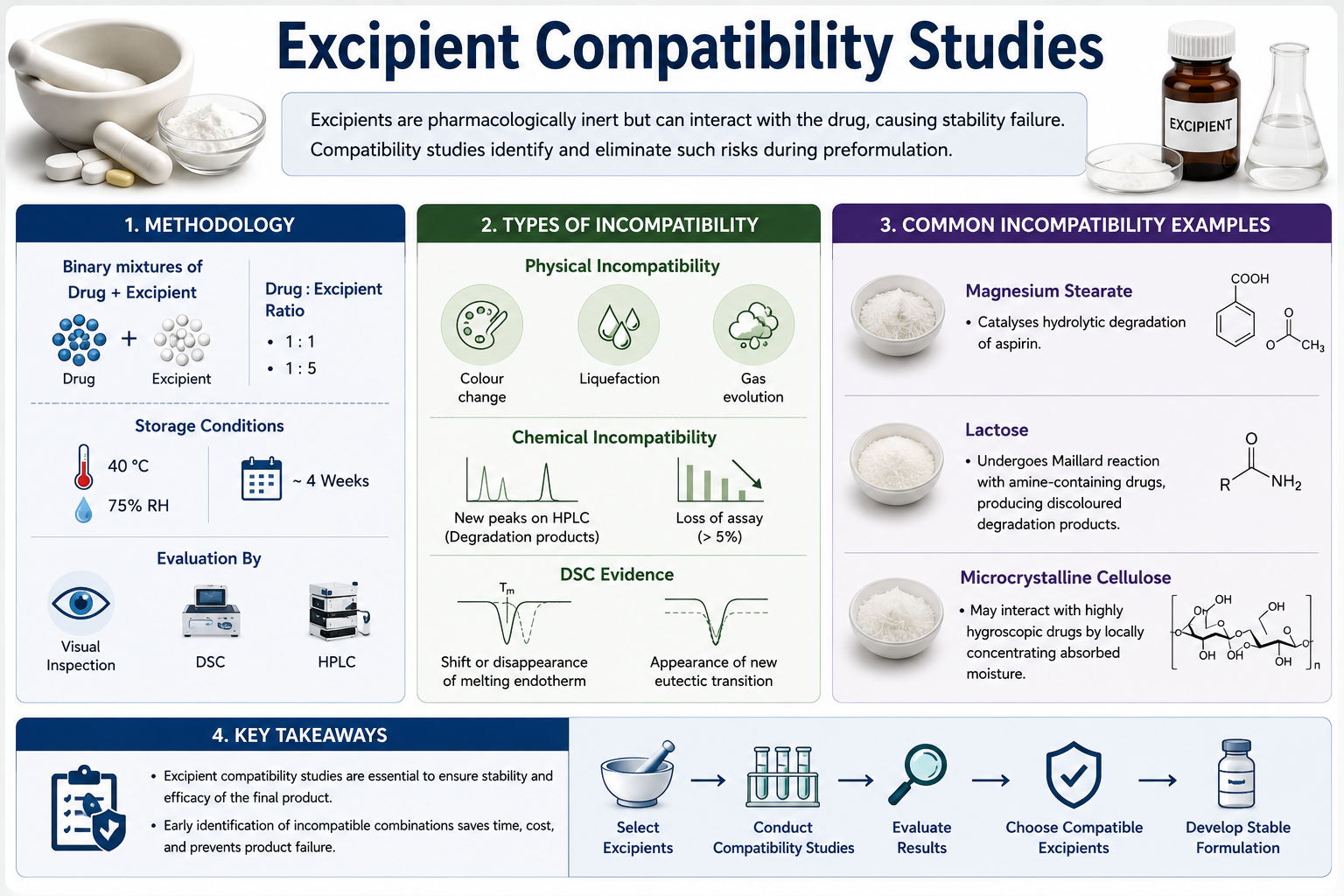
Excipients are pharmacologically inert substances included in a formulation to impart bulk, aid manufacture, control release, or enhance stability, yet despite their pharmacological inertness, excipients are capable of chemical or physical interaction with the active drug substance, and undetected incompatibilities represent one of the most common causes of stability failure in pharmaceutical products. Excipient compatibility studies are therefore conducted systematically during preformulation to identify and eliminate problematic excipient combinations before they are incorporated into a formal formulation.
The standard methodology involves preparing binary mixtures of the drug with each candidate excipient, typically at both a one-to-one and a one-to-five drug-to-excipient ratio, in order to accentuate any interaction that might otherwise be masked by a large excipient excess in the final formulation. These binary mixtures are stored under accelerated stress conditions, conventionally forty degrees Celsius and seventy-five per cent relative humidity, for a period of approximately four weeks, after which they are analysed by a combination of visual inspection, Differential Scanning Calorimetry, and high-performance liquid chromatography.
Incompatibilities are broadly classified into physical and chemical categories. Physical incompatibility manifests as observable changes such as colour alteration, liquefaction, or gas evolution, and is detected through straightforward visual inspection. Chemical incompatibility is more insidious, frequently undetectable by eye, and is revealed through the appearance of new peaks on high-performance liquid chromatography corresponding to degradation products, or through an unacceptable loss of drug assay, conventionally a decline exceeding five per cent. Differential Scanning Calorimetry provides a complementary line of evidence, since a shift or disappearance of the drug's characteristic melting endotherm in the presence of an excipient, or the appearance of a new eutectic transition, is strongly suggestive of a molecular-level interaction.
Certain excipient-drug incompatibilities recur across the pharmaceutical literature and are well documented as cautionary examples: magnesium stearate, a near-ubiquitous tablet lubricant, is known to catalyse the hydrolytic degradation of aspirin; lactose, an extremely common diluent, undergoes the Maillard reaction with primary and secondary amine-containing drugs, producing discoloured degradation products; and microcrystalline cellulose, despite its general inertness, can interact adversely with highly hygroscopic active substances by locally concentrating absorbed moisture. Awareness of such precedents allows the preformulation scientist to anticipate and pre-emptively screen for analogous risks in structurally related molecules.
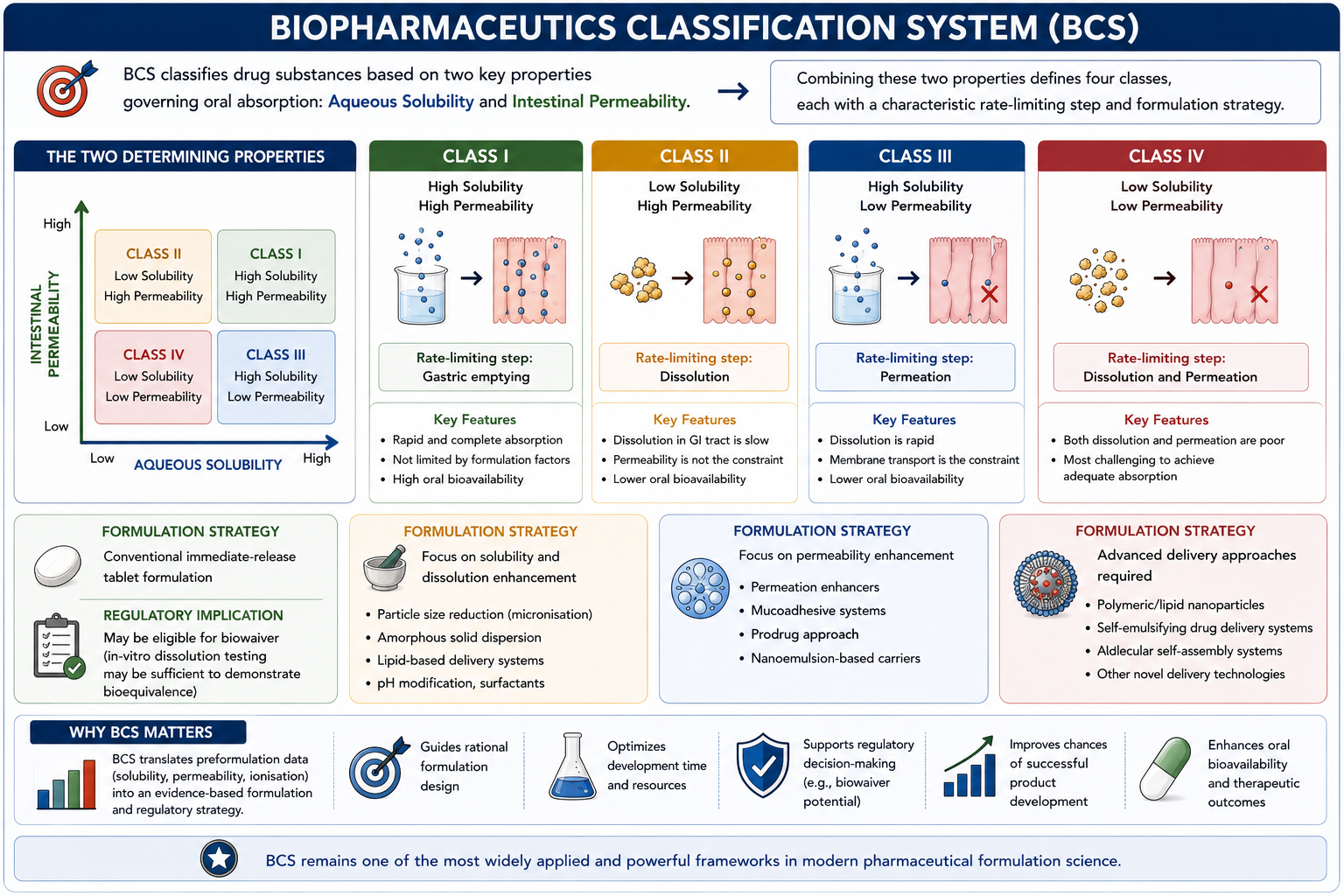
The Biopharmaceutics Classification System, universally abbreviated BCS, is a scientific framework that categorises drug substances according to two fundamental properties governing oral absorption: aqueous solubility and intestinal permeability. By combining these two axes, the system defines four classes, each associated with a characteristic rate-limiting step in oral absorption and, correspondingly, a distinct formulation strategy.
BCS Class I compounds exhibit both high solubility and high permeability, and consequently their oral absorption is rapid and essentially complete, limited only by gastric emptying rather than by any formulation-dependent factor. Such molecules are generally amenable to simple, conventional immediate-release tablet formulation and, under appropriate conditions, may qualify for a biowaiver, permitting demonstration of bioequivalence through in-vitro dissolution testing alone, without the need for a clinical bioequivalence study. BCS Class II compounds combine low solubility with high permeability, meaning that dissolution within the gastrointestinal tract, rather than membrane permeation, is the rate-limiting step governing absorption; formulation strategies for this class focus heavily on solubility and dissolution enhancement, employing techniques such as particle size reduction through micronisation, conversion to an amorphous solid dispersion, or incorporation into a lipid-based delivery system.
BCS Class III compounds present the inverse challenge: high aqueous solubility but low intestinal permeability, such that membrane transport, not dissolution, limits absorption. Formulation approaches for this class centre on enhancing permeability, for example through the inclusion of penetration enhancers, the design of mucoadhesive systems that prolong intestinal residence time, prodrug strategies that improve membrane transport, or nanoemulsion-based carriers. BCS Class IV compounds are the most formulation-challenging category, exhibiting both low solubility and low permeability, such that both dissolution and permeation constrain absorption simultaneously; these molecules typically require the most sophisticated delivery strategies available, including polymeric or lipid nanoparticles, self-emulsifying drug delivery systems, or molecular self-assembly approaches, several of which are discussed in detail in the chapter addressing novel drug delivery systems.
The Biopharmaceutics Classification System therefore serves as a decisive strategic tool at the conclusion of the preformulation phase, translating the accumulated solubility, permeability, and ionisation data into a clear, evidence-based recommendation for the formulation approach most likely to succeed with a given molecule, and it remains, decades after its introduction, one of the most widely applied frameworks in rational pharmaceutical formulation design.