
Stability Studies
Stability studies evaluate how the quality of a drug substance or drug product changes over time under the influence of environmental factors — principally temperature, humidity, and light — with the purpose of establishing an appropriate shelf-life, or expiry period, and the storage conditions under which that shelf-life can be guaranteed. This area of pharmaceutics is governed comprehensively by the ICH Q1 series of guidelines: Q1A(R2) for the general testing of new drug substances and products, Q1B for photostability, Q1C for stability testing requirements applicable to new dosage forms, and Q1E for the statistical evaluation of stability data. This chapter addresses the testing conditions specified under this framework, the manner in which protocols are tailored to different dosage form categories, the kinetic models used to characterise degradation, and the methods used to translate degradation data into a defensible shelf-life.
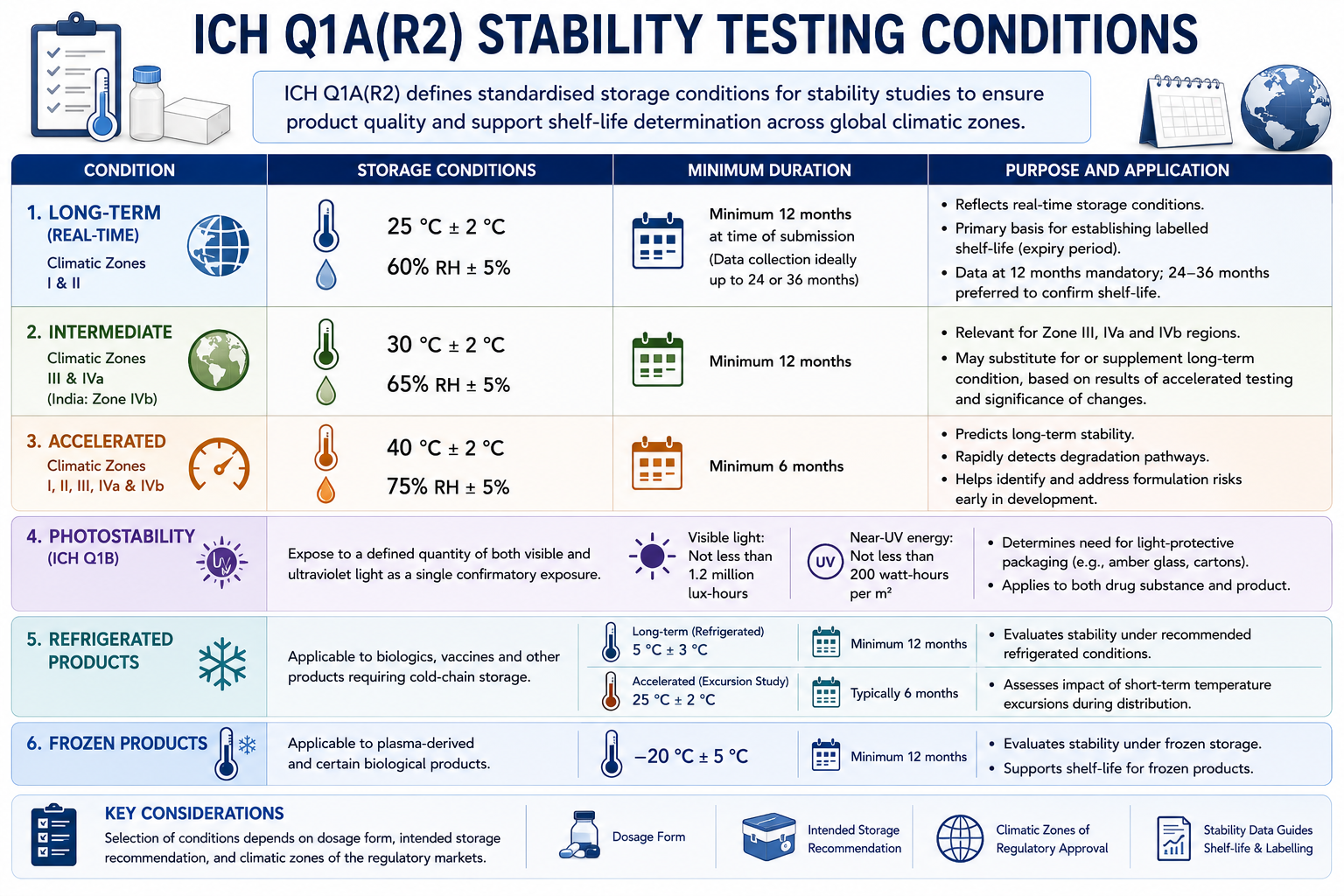
ICH Q1A(R2) defines a set of standardised storage conditions under which stability data must be generated, reflecting the range of climatic conditions encountered across the major global regulatory regions. Long-term testing, conducted at 25 degrees Celsius plus or minus 2 degrees and 60 per cent relative humidity plus or minus 5 per cent, corresponding to Climatic Zones I and II, is maintained for a minimum of twelve months at the time of regulatory submission, with data collection ideally continuing to 24 or 36 months to confirm the proposed shelf-life; this condition is intended to reflect real-time storage and forms the primary basis for the labelled expiry period.
An intermediate condition, 30 degrees Celsius plus or minus 2 degrees and 65 per cent relative humidity plus or minus 5 per cent, corresponding to Climatic Zones III and IVa, is maintained for a minimum of twelve months and is of particular relevance to regulatory submissions in India and other Zone IVb territories, where this condition may substitute for or supplement the standard long-term condition depending on the significance of any change observed under accelerated testing. Accelerated testing, conducted at the more aggressive condition of 40 degrees Celsius plus or minus 2 degrees and 75 per cent relative humidity plus or minus 5 per cent, is maintained for a minimum of six months and serves to predict long-term stability performance and to rapidly detect degradation pathways that might take years to manifest under real-time storage conditions, allowing formulation risks to be identified and addressed early in development.
Photostability testing, governed by the companion guideline ICH Q1B, exposes the drug substance and product to a defined quantity of both visible and ultraviolet light — conventionally not less than 1.2 million lux-hours of visible illumination together with an integrated near-ultraviolet energy of not less than 200 watt-hours per square metre — as a single confirmatory exposure, informing packaging decisions such as the need for light-protective primary containers or secondary cartons for photolabile compounds.
For products requiring cold-chain storage, such as many biologics and vaccines, refrigerated stability testing is conducted at 5 degrees Celsius plus or minus 3 degrees for long-term evaluation, typically for twelve months, supplemented by accelerated testing at 25 degrees Celsius to stress-test the formulation's tolerance of transient excursions from labelled storage conditions during distribution. Frozen products, including certain plasma-derived and biological preparations, are evaluated at minus 20 degrees Celsius plus or minus 5 degrees for a minimum of twelve months. Selection of the appropriate combination of these conditions for a given development programme depends on the dosage form, the intended storage recommendation, and the specific climatic zones in which regulatory approval is being sought.
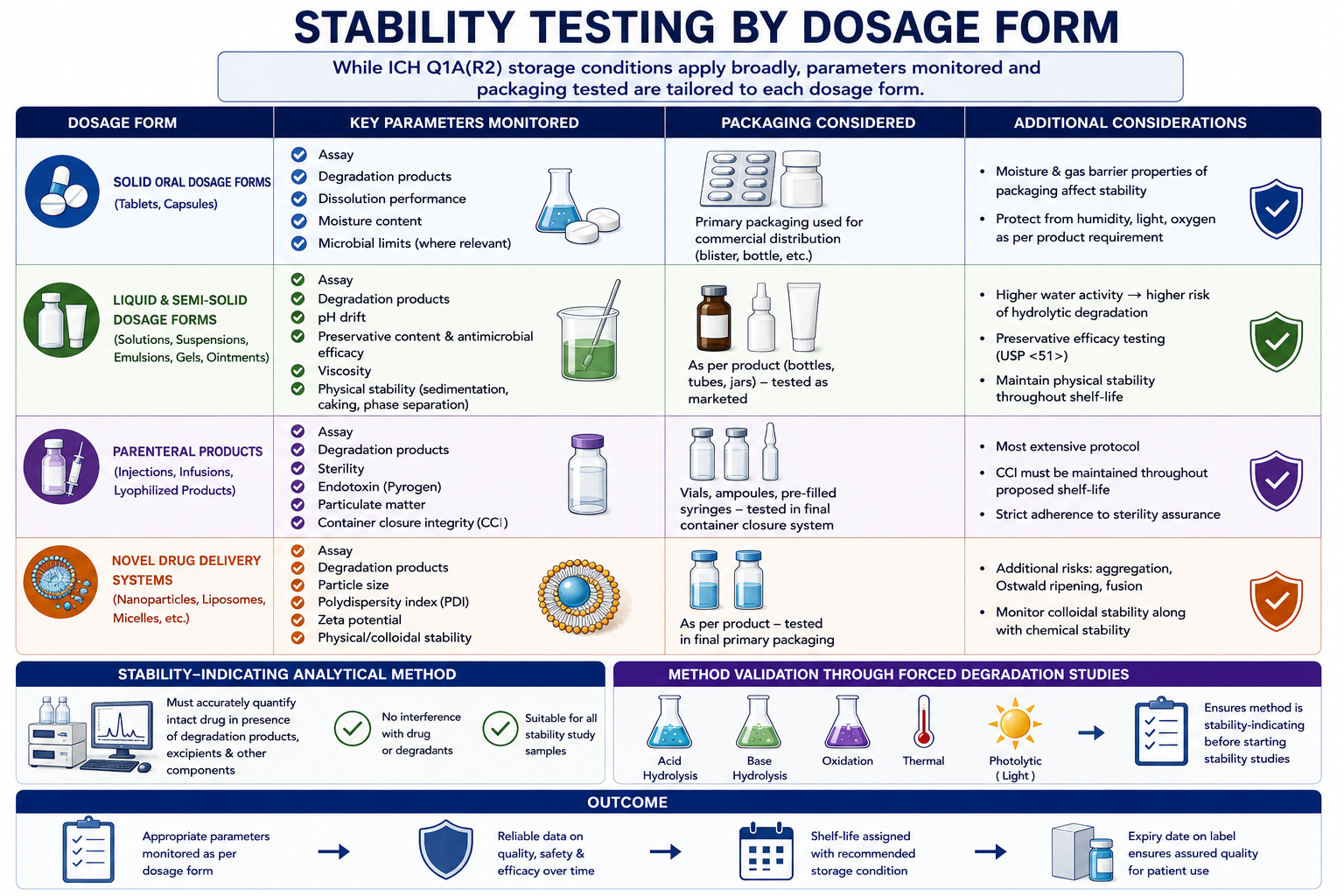
While the ICH Q1A(R2) storage conditions apply broadly across dosage form categories, the specific stability-indicating parameters monitored, and the packaging configurations tested, are tailored to the physical and chemical characteristics of each dosage form. For solid oral dosage forms such as tablets and capsules, the stability protocol typically monitors assay, degradation products, dissolution performance, moisture content, and, where relevant, microbial limits, with samples stored in the primary packaging configuration intended for commercial distribution, since the moisture and gas barrier properties of blister packaging or bottle-closure systems directly influence the observed stability outcome.
Liquid and semi-solid dosage forms present additional stability considerations beyond those relevant to solids, owing to the greater molecular mobility and higher water activity characteristic of these systems, which generally accelerates hydrolytic degradation pathways. Stability protocols for liquids and semi-solids therefore place particular emphasis on pH drift over time, preservative content and continued antimicrobial efficacy, viscosity change, and, for suspensions and emulsions, physical stability parameters such as sedimentation, caking, or phase separation, in addition to the chemical assay and degradation product monitoring applied to all dosage forms.
Parenteral products require the most extensive stability protocol of all dosage form categories, incorporating not only chemical assay and degradation product testing but also sterility confirmation, endotoxin testing, particulate matter assessment, and, critically, container closure integrity testing throughout the proposed shelf-life, since any compromise of container closure integrity during storage would place the sterility of the product at risk. Novel drug delivery systems such as nanoparticles and liposomes require yet further protocol customisation, incorporating the colloidal stability parameters discussed in the previous chapter — particle size, polydispersity index, and zeta potential — alongside conventional chemical stability testing, reflecting the additional physical instability mechanisms, such as aggregation and Ostwald ripening, to which these systems are uniquely susceptible.
Across all dosage form categories, the selection of stability-indicating analytical methods is itself a matter of rigorous scientific and regulatory scrutiny: a stability-indicating method must be capable of accurately quantifying the intact drug substance in the presence of its degradation products, excipients, and any other formulation components, without interference, and the validation of such methods — commonly through forced degradation studies employing acid, base, oxidative, thermal, and photolytic stress — is itself an essential preparatory activity that precedes the initiation of any formal stability study.
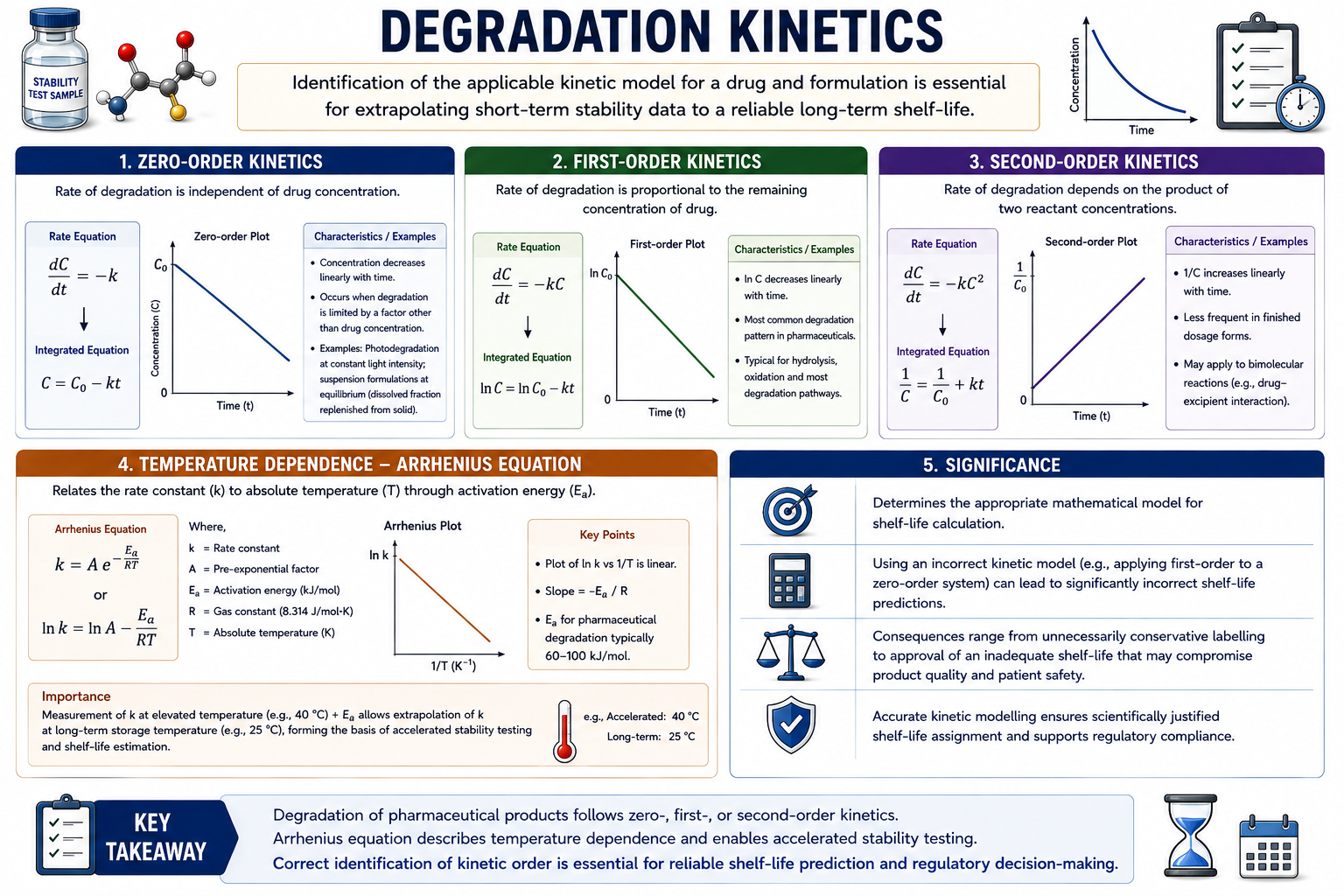
Chemical degradation of pharmaceutical products generally follows one of several well-characterised kinetic orders, and identification of the applicable kinetic model for a given drug and formulation is a prerequisite for extrapolating short-term stability data into a defensible long-term shelf-life prediction. Zero-order kinetics, in which the concentration of intact drug decreases linearly with time independent of the remaining drug concentration, is described by the relationship C equals C0 minus kt, and is characteristic of degradation processes limited by a factor other than drug concentration, such as photodegradation at constant light intensity or certain suspension formulations in which degradation occurs only within the dissolved fraction, replenished continuously from the solid reservoir as the system approaches equilibrium.
First-order kinetics, by contrast, describes a degradation rate proportional to the remaining concentration of intact drug, expressed as the natural logarithm of concentration decreasing linearly with time, and represents the most commonly observed degradation pattern in pharmaceutical systems, characteristic of hydrolysis and oxidation reactions that constitute the majority of drug degradation pathways encountered in practice. Second-order kinetics, in which the reaction rate depends on the product of two reactant concentrations, is encountered less frequently in finished dosage forms but may apply to certain bimolecular degradation reactions, such as those between a drug and a specific excipient or degradant.
The temperature dependence of degradation rate constants is described by the Arrhenius equation, which relates the natural logarithm of the rate constant linearly to the reciprocal of absolute temperature through the activation energy of the degradation reaction, a parameter typically falling in the range of sixty to one hundred kilojoules per mole for pharmaceutical degradation processes. This relationship provides the theoretical basis for accelerated stability testing, since measurement of the degradation rate constant at an elevated temperature, such as the 40-degree accelerated condition, together with a determination or reasonable estimate of the activation energy, permits extrapolation of the expected degradation rate at the intended long-term storage temperature, substantially shortening the time required to generate a preliminary shelf-life estimate.
Establishing the correct kinetic order for a given formulation is not a purely academic exercise: it directly determines which mathematical model is appropriate for shelf-life calculation, and a formulation scientist who applies a first-order model to a system that in fact follows zero-order kinetics, or vice versa, risks generating a materially incorrect shelf-life prediction, with consequences ranging from unnecessarily conservative labelling to, in the worst case, an approved shelf-life that does not adequately reflect the true stability of the product.
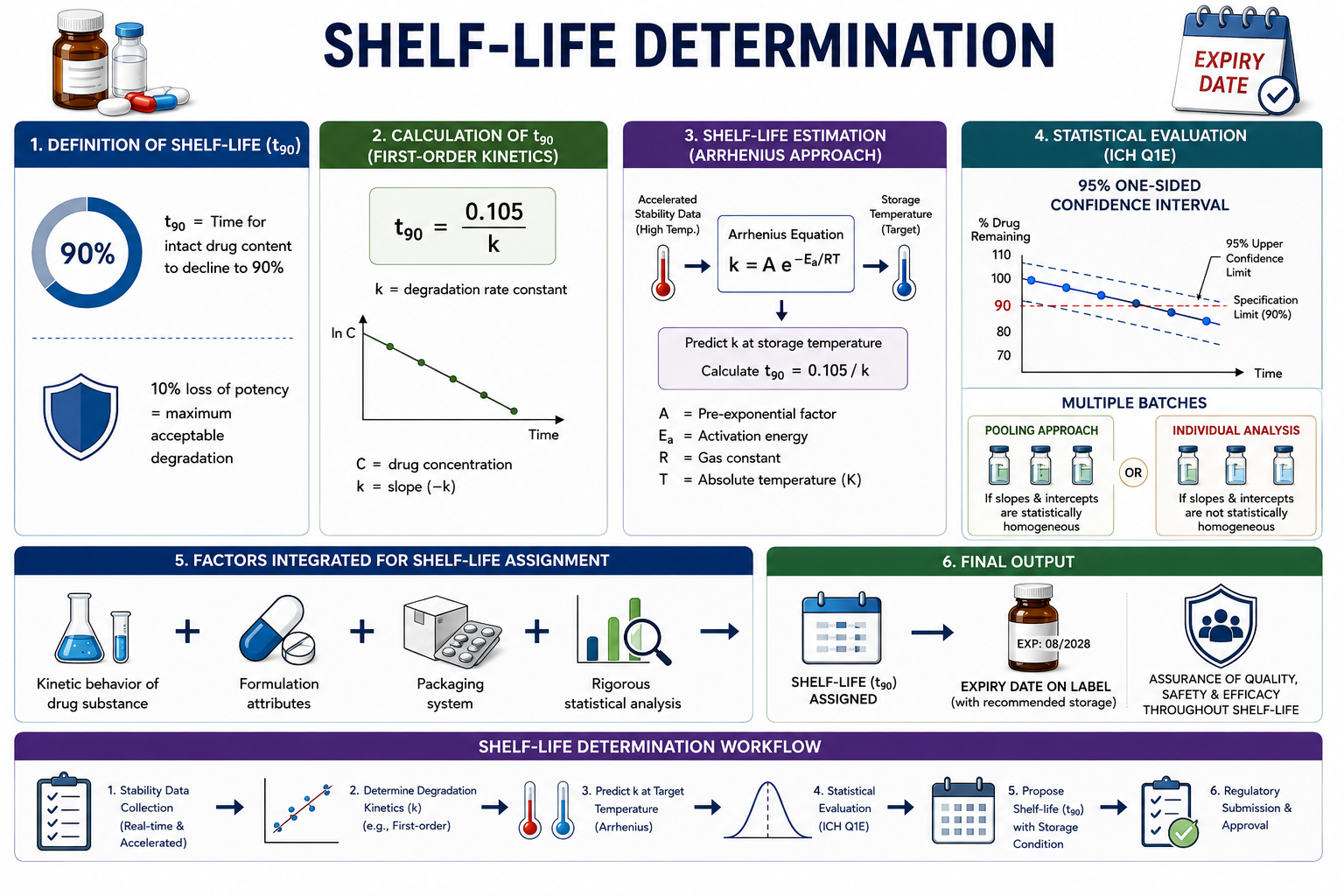
The shelf-life of a pharmaceutical product is conventionally defined by the parameter t90, the time required for the intact drug content to decline to 90 per cent of its labelled or initial value, reflecting the widely applied regulatory convention that a 10 per cent loss of potency represents the maximum acceptable degradation before a product is considered to have expired. For a drug substance following first-order degradation kinetics, t90 is calculated directly from the degradation rate constant through the relationship t90 equals 0.105 divided by k, a formula derived directly from the first-order integrated rate equation evaluated at the 90 per cent retention endpoint.
Where long-term stability data at the intended storage temperature is not yet available at the time shelf-life must be estimated — as is invariably the case during early development, when regulatory submission timelines require a shelf-life projection well before multi-year real-time data can be generated — the Arrhenius relationship is employed to predict the rate constant, and hence t90, at the intended storage temperature from data generated under accelerated conditions, using either an experimentally determined activation energy or, where this has not been separately established, a conservative literature-based estimate.
ICH Q1E provides the statistical framework governing the formal evaluation of stability data and the derivation of a regulatory shelf-life, specifying that the proposed shelf-life should be supported by a 95 per cent one-sided confidence interval for the mean degradation trend that remains within the approved specification limit throughout the proposed storage period, a statistically conservative approach that accounts for both the observed variability in the stability data and the uncertainty inherent in extrapolating beyond the period of directly observed data. Where multiple batches are available, ICH Q1E additionally provides statistical criteria for determining whether batch data can be pooled for the purpose of shelf-life estimation or must instead be evaluated individually, based on formal statistical tests of the homogeneity of degradation slopes and intercepts across batches.
The shelf-life ultimately assigned to a product, together with its recommended storage condition, represents the culmination of the entire stability programme, integrating the kinetic behaviour of the drug substance, the protective or degradative influence of the formulation and packaging system, and rigorous statistical analysis, and it is this figure — expressed on every product label as an expiry date — that provides patients and healthcare providers with the assurance that a medicine will retain its labelled potency and quality throughout its intended period of use.