WHO Good Agricultural and Collection Practices (GACP)
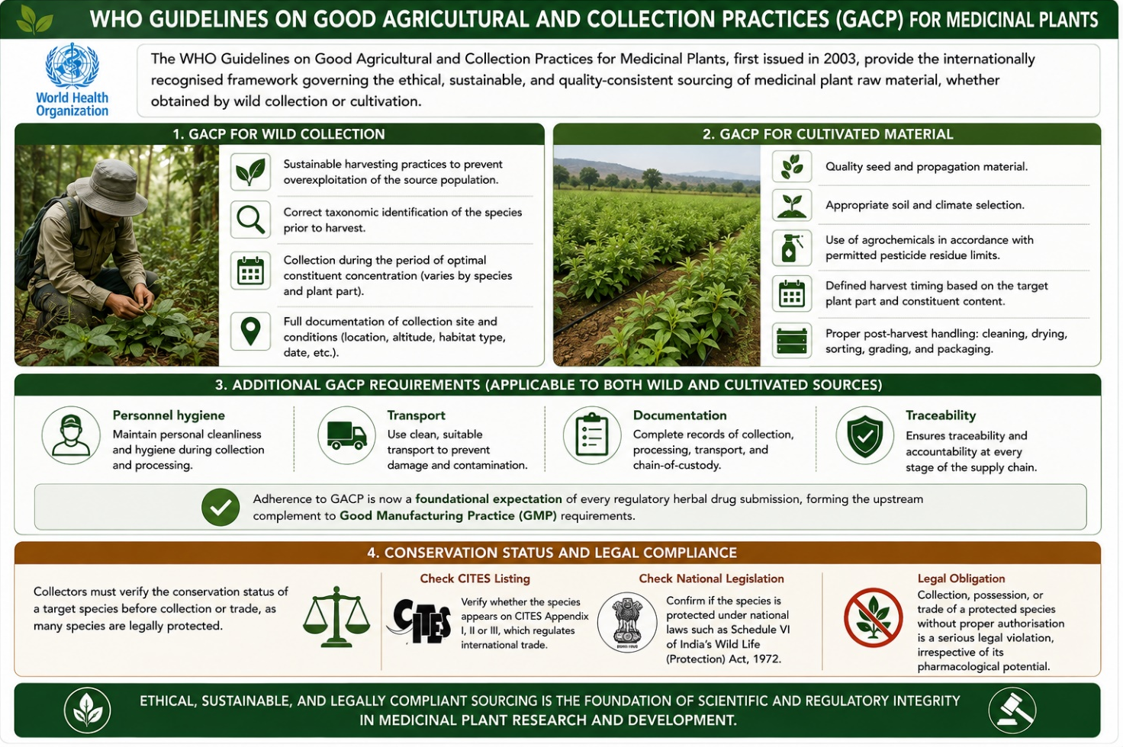
The WHO Guidelines on Good Agricultural and Collection Practices for Medicinal Plants, first issued in 2003, provide the internationally recognised framework governing the ethical, sustainable, and quality-consistent sourcing of medicinal plant raw material, whether obtained by wild collection or cultivation. For wild collection, GACP specifies sustainable harvesting practices that prevent overexploitation of the source population, correct taxonomic identification prior to harvest, collection during the period of optimal constituent concentration (which varies by species and plant part), and full documentation of the collection site and conditions. For cultivated material, GACP addresses seed and propagation material quality, appropriate soil and climate selection, agrochemical use consistent with permitted pesticide residue limits, and defined harvest timing and post-harvest handling. GACP compliance additionally requires attention to personnel hygiene during collection and processing and to full transport and chain-of-custody documentation, and adherence to these guidelines is now a foundational expectation of every regulatory herbal drug submission, forming the upstream complement to the Good Manufacturing Practice requirements addressed later in this text.
A further consideration integral to ethical and legal sourcing is the verification of a species' conservation status: collectors must confirm whether a target species appears on a CITES (Convention on International Trade in Endangered Species) appendix or is protected under national legislation such as Schedule VI of India's Wild Life (Protection) Act, 1972, since the collection or trade of a protected species without appropriate authorisation constitutes a serious legal violation irrespective of its pharmacological promise.