
Compendial Dissolution Apparatus
The United States Pharmacopeia describes several standardised dissolution apparatus configurations, of which the basket apparatus, designated Apparatus One, and the paddle apparatus, designated Apparatus Two, are by far the most widely employed for conventional immediate-release and extended-release solid oral dosage forms. The basket apparatus rotates a cylindrical mesh basket containing the dosage form within the dissolution vessel, and is particularly suited to capsules and dosage forms that tend to float, whereas the paddle apparatus employs a rotating paddle positioned above a dosage form resting at the base of the vessel and is the more commonly used configuration for tablets. Additional apparatus configurations include the reciprocating cylinder, useful for extended-release and chewable formulations, and the flow-through cell, particularly valuable for poorly soluble drugs, suspensions, and implants requiring continuous replenishment of fresh dissolution medium.
Dissolution testing is an analytical test used to measure the rate and extent of drug release from a solid dosage form (such as tablets and capsules) into a dissolution medium under standardized laboratory conditions. It serves as an important quality control tool and helps predict the in vivo performance of pharmaceutical products.
Dissolution testing is performed to:
- Ensure batch-to-batch consistency.
- Predict the drug's in vivo performance and bioavailability.
- Support formulation development and optimization.
- Verify compliance with pharmacopeial specifications.
- Establish bioequivalence and IVIVC.
- Detect formulation or manufacturing changes that may affect drug release.
- Monitor product quality throughout its shelf life.
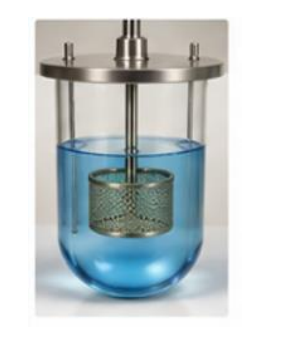
Principle
The dosage form is placed inside a wire mesh basket, which rotates in the dissolution medium at a constant speed.
Applications
- Hard gelatin capsules
- Soft gelatin capsules
- Floating dosage forms
- Extended-release capsules
Advantages
- Prevents floating of capsules.
- Suitable for dosage forms that tend to float.
- Provides uniform exposure to the dissolution medium.
Limitation
Less commonly used for conventional tablets.
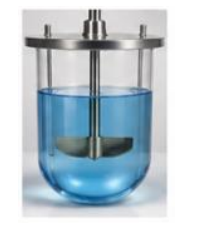
Principle
The dosage form is placed at the bottom of the vessel while a paddle rotates above it, creating uniform mixing.
Applications
- Immediate-release tablets
- Most conventional tablets
- Extended-release tablets
Advantages
- Most widely used apparatus.
- Easy to operate.
- Suitable for routine quality control testing.
- Produces reproducible results.
Limitation
Floating dosage forms may require sinkers.
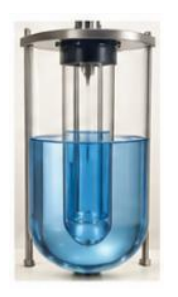
Principle
The dosage form moves vertically between different vessels containing dissolution media using a reciprocating cylinder.
Applications
- Extended-release formulations
- Chewable tablets
- Floating dosage forms
- Modified-release dosage forms
Advantages
- Simulates changing gastrointestinal conditions.
- Suitable for dosage forms requiring multiple pH environments.
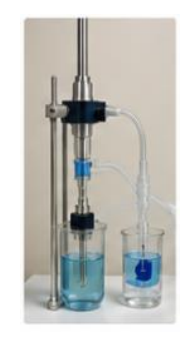
Principle
Fresh dissolution medium is continuously pumped through a flow-through cell containing the dosage form.
Applications
- Poorly soluble drugs
- Suspensions
- Implants
- Modified-release dosage forms
Advantages
- Maintains sink conditions.
- Suitable for poorly soluble drugs.
- Provides continuous renewal of dissolution medium.
A reliable dissolution method requires careful optimization of several experimental variables.
1. Selection of Dissolution Medium
The dissolution medium should simulate physiological conditions and provide adequate drug solubility. Examples include:
- 0.1 N Hydrochloric Acid (pH 1.2)
- Acetate Buffer (pH 4.5)
- Phosphate Buffer (pH 6.8)
- Water
2. Temperature
The dissolution medium is maintained at 37 ± 0.5°C to simulate human body temperature.
3. Agitation Speed
The basket or paddle rotates at a predetermined speed. Typical speeds:
- 50 rpm
- 75 rpm
- 100 rpm
Proper agitation ensures uniform mixing without excessive turbulence.
4. Sampling Volume and Time
Samples are withdrawn at predetermined intervals such as:
- 5 min
- 10 min
- 15 min
- 30 min
- 45 min
- 60 min
Each withdrawn sample is analyzed using UV spectroscopy or HPLC.
5. Filtration and Analysis
The withdrawn sample is filtered to remove undissolved particles and then analyzed to determine the percentage of drug released.
Several factors influence dissolution performance:
- Sink conditions
- pH of the dissolution medium
- Dissolution apparatus used
- Rotation speed (RPM)
- Drug particle size
- Dosage form orientation
- Temperature
- Sampling intervals
- Filtration method
Optimizing these factors ensures a robust and reproducible method.
The Biopharmaceutics Classification System (BCS) classifies drugs according to their aqueous solubility and intestinal permeability. It helps predict drug absorption and guides formulation development.
Importance of BCS
- Predicts oral drug absorption.
- Guides formulation development.
- Supports biowaiver applications.
- Helps optimize dissolution methods.
- Assists regulatory decision-making.
In-Vitro In-Vivo Correlation (IVIVC) is a predictive mathematical relationship between the in vitro dissolution profile of a dosage form and its in vivo drug absorption. A good IVIVC allows dissolution data to predict how the drug will behave in the human body.
Levels of IVIVC
- Level A – Point-to-point correlation; highest level of correlation; most preferred by regulatory agencies.
- Level B – Statistical correlation using mean dissolution and mean absorption data; less predictive than Level A.
- Level C – Correlation between one dissolution parameter and one pharmacokinetic parameter; lowest predictive capability.
Benefits of IVIVC
- Predicts in vivo drug performance.
- Reduces the need for repeated bioequivalence studies.
- Supports formulation optimization.
- Assists post-approval changes.
- Facilitates regulatory approval.
- Reduces development time and cost.
Dissolution testing is a critical quality control and formulation development tool used to evaluate the rate and extent of drug release from solid dosage forms. Selection of the appropriate dissolution apparatus, optimization of experimental conditions, and understanding concepts such as BCS and IVIVC are essential for developing reliable, reproducible, and regulatory-compliant dissolution methods. Proper dissolution testing ensures consistent product quality, supports bioequivalence and biowaiver decisions, and helps predict the in vivo performance of pharmaceutical products.